

Spinal pathologies
Lumbar Disc Herniation
Lumbar disc herniation is one of the most frequent causes of lower back pain and sciatica, produced by the displacement or protrusion of the lumbar intervertebral disc that causes irritation or compression of the nerve roots.
This condition can cause persistent lower back pain, pain radiating to the buttocks and legs, sensory disturbances, muscle weakness, and significant functional limitations, significantly impacting the patient’s quality of life.
Lumbar disc herniation usually develops in the context of degenerative processes of the intervertebral disc, although it can also appear after physical exertion, trauma or biomechanical overload.

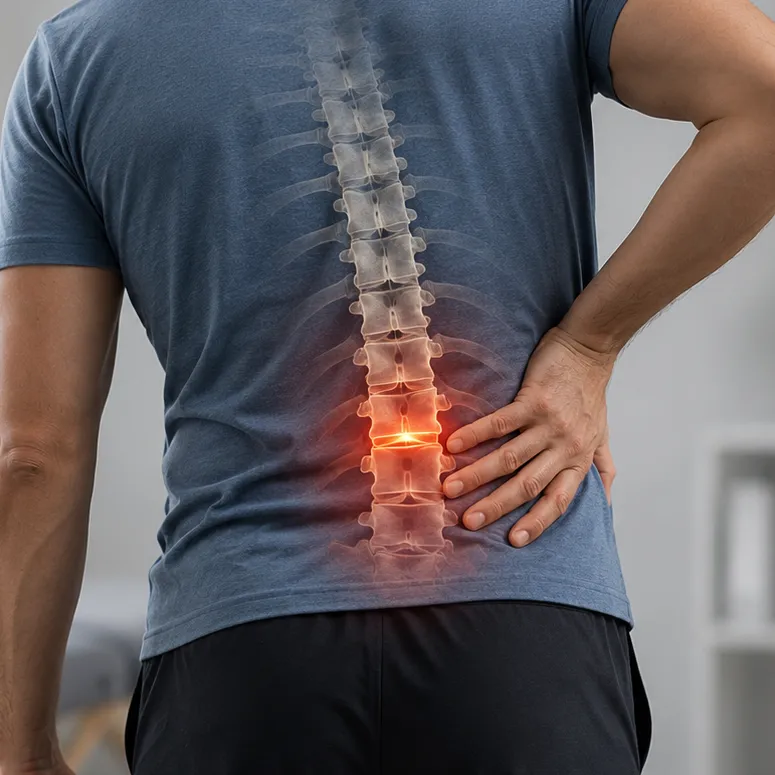
What is a lumbar intervertebral disc?
The intervertebral discs act as shock-absorbing structures between the lumbar vertebrae, allowing mobility and absorbing loads on the spine.
Each disc consists of a central gelatinous core and an outer fibrous ring that provides mechanical stability.
With aging and degenerative processes, the disc can lose hydration and elasticity, facilitating the appearance of disc protrusions or herniations that can compress the lumbar nerve roots.
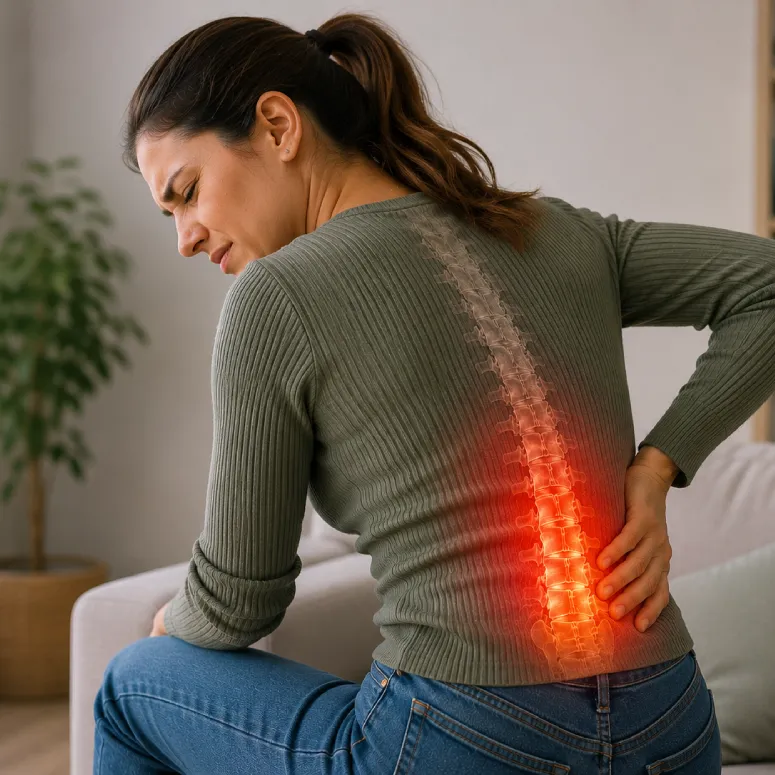
What are the most common symptoms?
The symptoms will depend on the size and location of the hernia, as well as the degree of nerve compression.
The most common symptoms include:
- Persistent lower back pain
- Sciatica or pain radiating down the leg
- Burning, electric shock, or stabbing pain
- Tingling or loss of sensation
- Muscle weakness in lower extremities
- Lumbar stiffness and functional limitation
- Pain that worsens with certain movements, exertion, or prolonged sitting
In advanced cases, significant neurological deficits or sphincter dysfunction may appear, requiring urgent evaluation.
Specialized diagnosis
Diagnosis requires a detailed clinical and neurological assessment along with advanced imaging studies.
Magnetic resonance imaging is the fundamental test to assess the degree of disc degeneration and neural compression.
Treatment of lumbar disc herniation
Treatment will depend on the intensity of the symptoms, the degree of neural compression, and the patient’s clinical evolution.
In many cases, initial treatment is conservative and includes:
- Specialized pharmacological treatment
- Physiotherapy and functional rehabilitation
- Postural re-education and muscle strengthening
- Inflammation and pain control
When pain persists or there is neurological involvement, advanced interventional techniques may be used, such as:
- Image-guided infiltrative treatments in the epidural cavity
- Radiofrequency discoplasty
- Neuromodulation
- Ozone discolysis
- Minimally invasive intradiscal techniques
- Regenerative disc medicine and mesenchymal cell therapy (stem cells)
- Spinal endoscopy and endoscopic microdiscectomy
In selected cases with significant neural compression or failure of conservative treatment, minimally invasive lumbar surgery may be necessary.
At VERTEBRA SpinePain & Regenerative SURGERY CENTERS we provide a comprehensive and personalized approach to degenerative lumbar pathology using advanced diagnostic techniques, interventional procedures and minimally invasive image-guided surgery.
Our goal is to relieve pain, preserve neurological function, and improve the patient’s quality of life through precise treatments tailored to each clinical situation.
VERTEBRA Clinic is a pioneer in the international field of Advanced Cell Therapies (cultured and expanded Adipose Tissue Stem or Mesenchymal Cells AD-MSCs) in its own Surgical Center and in high-level facilities for their production and storage (Biosafety Level III Clean Room)
Contact us and regain your quality of life
